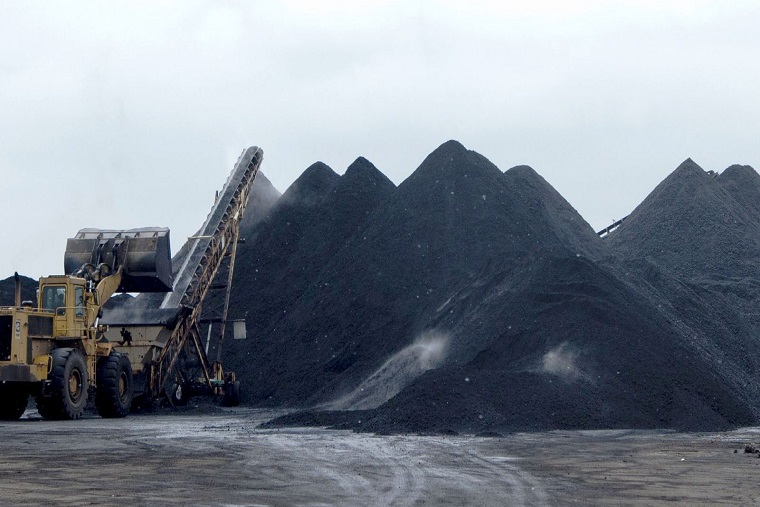
Petroleum coke (Petcoke) is a carbonaceous solid by-Products from oil refinery coker units or other cracking processes.Petcoke is used as a fuel and as a source of carbon for industrial processes. Petcoke is produced after crude oil undergoes two processes. First, the oil is distilled into various Products, separating out the light parts of the oil — the gasoline vapours, liquid petroleum gas (LPG), naphtha, and kerosene from the heavier parts of the oil. The heavier portion of the oil, Vacuum Residue (VR), in then processed through a “coker” which subjects the remaining VR to high heat and pressure to extract as much of the lighter gasoline – like parts of the oil as possible. What remains after the coker after the high heat and pressure is a substance called petroleum coke.Petroleum coke is high in carbon — this makes it chemically similar to coal and both energy dense and useful for many industrial processes that require carbon.
Petcoke Type
Fuel Grade Petcoke
About 70-80% Petcoke is usually used as a fuel to make cement, lime, brick, glass, steel, and fertilizer as well as many other industrial applications.
Calcined Grade Petcoke
Calcined Petcoke is Petcoke that is again heated to remove moisture, volatile matter, and impurities and to increase the electrical conductivity. Calcinced Petcoke is used to make steel, graphite and titanium.
Petroleum coke (Petcoke) is a carbon-rich solid by-product from oil refinery coker units or other cracking processes. It is used as a fuel and a carbon source in industrial processes. Petcoke is formed after crude oil is first distilled to separate lighter products like gasoline vapours, LPG, naphtha, and kerosene from heavier components. The remaining Vacuum Residue (VR) is then heated under high pressure in a coker to extract more light products. What remains is petroleum coke, which is high in carbon, energy-dense, and chemically similar to coal.
Petroleum coke is a carbonaceous solid by-product from oil refinery coker units or other cracking processes.
Petcoke is used as a fuel and as a source of carbon for industrial processes.
First, the oil is distilled into various products, separating out the light parts of the oil — the gasoline vapours, liquid petroleum gas (LPG), naphtha, and kerosene — from the heavier parts of the oil.
The heavier portion of the oil, Vacuum Residue (VR), is then processed through a “coker,” which subjects the remaining VR to high heat and pressure to extract as much of the lighter gasoline-like parts of the oil as possible.
What remains after the coker, after the high heat and pressure, is a substance called petroleum coke.
Petroleum coke is high in carbon — this makes it chemically similar to coal and both energy-dense and useful for many industrial processes that require carbon.
Fuel Grade Petcoke
Parameter
Unit
Value
Gross Calorific Value (ADB)
Kcal/kg
Min 8200
Net Calorific Value (ARB)
Kcal/kg
Min 7500
Fixed Carbon
%
87-88
Ash Content (DB)
%
< 1
Sulphur (DB)
%
< 7
Volatile Matter (DB)
%
8-12
Moisture (ARB)
%
< 8
Fuel Grade Petcoke
Waste Heat Utilization Benefits
Calcined Grade Petcoke
Calcined Petcoke is Petcoke that is again heated to remove moisture, volatile matter, and impurities and to increase the electrical conductivity. Calcinced Petcoke is used to make steel, graphite and titanium.